Digital Video Broadcasting — Cable (DVB-C)
| Broadcast | |
|---|---|
| Analogue Radio: AM radio - FM radio Digital Radio: DRM - DAB |
 | |
|---|---|
| Frequencies | 366 MHz,662 MHz |
| Frequency Range | 366 MHz - 662 MHz |
| Mode | — |
| Modulation | 16QAM,32QAM,64QAM,128QAM,256QAM |
| ACF | — |
| Emission Designator | — |
| Bandwidth | 6 MHz,7 MHz,8 MHz |
| Location | Europe |
| Short Description | DVB‑C is a cable‑based digital TV transmission standard that delivers MPEG transport streams over coaxial networks using QAM modulation. It was first published as ETSI EN 300 429 and defines the framing, channel coding, and modulation needed for reliable multi‑program distribution via cable. The system uses 16‑QAM up to 256‑QAM, allowing high spectral efficiency while maintaining very low error rates thanks to forward error correction. It has become the dominant global standard for digital cable TV outside North America. |
| I/Q Raw Recording | Download file |
| Audio Sample | |
DVB‑C is a cable‑based digital TV transmission standard that delivers MPEG transport streams over coaxial networks using QAMQuadrature Amplitude Modulation modulation. It was first published as ETSIEuropean Telecommunications Standards Institute. An independent, not-for-profit, standardization organization in the telecommunications industry in Europe, developing global telecommunications standards. EN 300 429 and defines the framing, channel coding, and modulation needed for reliable multi‑program distribution via cable. The system uses 16‑QAMQuadrature Amplitude Modulation up to 256‑QAMQuadrature Amplitude Modulation, allowing high spectral efficiency while maintaining very low error rates thanks to forward error correction. It has become the dominant global standard for digital cable TV outside North America.
Transmission medium: coaxial cable networks designed for broadcast distribution Modulation: QAMQuadrature Amplitude Modulation (16/32/64/128/256), enabling high data throughput Coding: MPEG‑2 transport stream with FECForward Error Correction to achieve quasi‑error‑free performance Use cases: multi‑channel digital TV distribution, including hundreds of millions of households worldwide
DVB‑C is often compared with DVB‑S and DVB‑T as part of the broader DVB family, which provides open standards for satellite, cable, and terrestrial digital broadcasting.
Additional Images[edit]
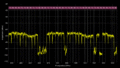
DVB-C TV multiplex channels over the cable


